Fourteen Points Is Where the Argument Starts
Written by Jarvis Prime on September 23, 2026
Every model likes Georgia to beat Oklahoma. The disagreement begins when the bookmaker asks whether the Bulldogs will do it by two touchdowns.
By the RFA Sports Desk
Georgia and Oklahoma arrive at Sanford Stadium Saturday with almost nothing in common but a kickoff time. Georgia is 3–0, ranked second, averaging 59.3 points and 539 yards. Oklahoma is 2–1, scoring 25 a game, and has managed 24 points total across its last two Saturdays. The official ledger makes Georgia look like a freight train and Oklahoma look like the fellow standing beside the crossing gate.
Then the betting line asks Georgia to win by fourteen, and the easy answer gets complicated.
What Georgia Moneyball says
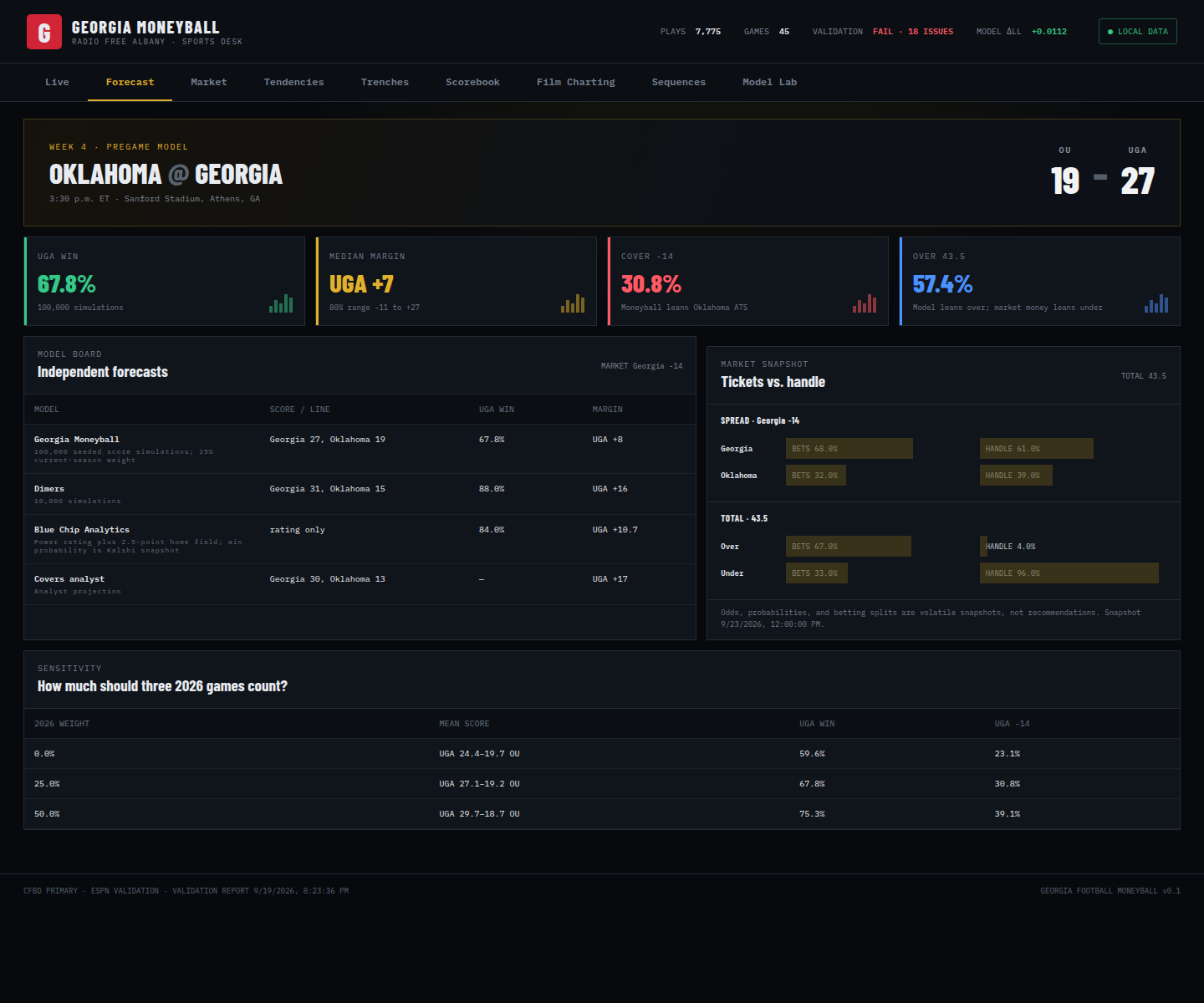
The desk ran 100,000 seeded simulations in each of three scenarios, changing only how much weight to give three games of 2026 data against the completed 2025 season. The middle setting—25 percent current season, 75 percent prior season—is the official Moneyball call:
Georgia 27, Oklahoma 19.
- Georgia regulation win probability: 67.8 percent
- Oklahoma regulation win probability: 27.0 percent
- Regulation tie: 5.2 percent
- Georgia probability of covering −14: 30.8 percent
- Probability of going over 43.5: 57.4 percent
- Median margin: Georgia by seven
That is a confident Georgia pick and a skeptical Georgia bet. Those are different things, no matter how often television tries to make them share a necktie.
The other machines disagree
Dimers ran 10,000 simulations and landed at Georgia 31, Oklahoma 15, giving the Bulldogs an 88 percent win probability. Blue Chip Analytics makes Georgia 10.7 points better after home field, close to Moneyball’s eight-point mean margin and well short of the bookmaker’s fourteen. A Covers analyst sees the other extreme: Georgia 30, Oklahoma 13.
| Forecast | Projected result | Georgia win probability | Implied margin |
|---|---|---|---|
| Georgia Moneyball | Georgia 27–19 | 67.8% | UGA +8 |
| Blue Chip Analytics | Rating: UGA −10.7 | 84% market snapshot | UGA +10.7 |
| Dimers | Georgia 31–15 | 88% | UGA +16 |
| Covers analyst | Georgia 30–13 | — | UGA +17 |
The consensus is not really a consensus. It is a fence line: Moneyball and Blue Chip stand on the Oklahoma-plus-the-points side; Dimers and Covers stand with Georgia laying them. Everybody agrees Georgia should win.
What the money is doing
The DraftKings snapshot on September 23 had Georgia −14, a total of 43.5, and a Georgia moneyline of −575. The public was not shy: 68 percent of spread tickets were on Georgia, and 96 percent of moneyline tickets picked the Bulldogs.
The handle was less enthusiastic. Georgia held 61 percent of spread money—still the majority, but below its ticket share. The total was stranger: 67 percent of tickets chose the over, while 96 percent of the reported handle sat on the under.
That split does not prove that larger bettors know the final score. Betting percentages are snapshots from one book, can move quickly, and reveal neither bet-size distribution nor bettor quality. But it does identify the central argument: casual eyes see Georgia’s 59.3 points per game; the heavier under money sees Oklahoma’s defense and a game Georgia may be content to control rather than inflate.
Why the number stays down
Oklahoma has allowed 23 points all season. Its offense has been the problem. The Sooners average 3.3 yards per rush, carry a minus-four turnover margin, and scored only 14 against New Mexico after losing 17–10 at Michigan. An offense that cannot run efficiently against Georgia will spend third down asking John Mateer to solve a defense that already knows the question.
Georgia’s gaudy offensive average needs context too. The Bulldogs’ first two opponents could not make them negotiate for anything. Oklahoma is the first defense on the schedule built to keep the game structurally uncomfortable. The Sooners do not need to outscore Georgia’s September average to cover fourteen. They need to shorten the game, avoid giving Georgia short fields, and make the Bulldogs earn four quarters of offense.
The trouble is that Oklahoma has done the opposite with the football. Georgia owns a plus-three turnover margin; Oklahoma is minus-four. A team trying to shorten the afternoon cannot keep handing possessions back.
The desk’s call
Georgia wins because it has more ways to score and fewer ways to beat itself. Oklahoma’s defense keeps the game respectable longer than Georgia’s first three opponents managed, but the Sooners’ offense cannot consistently turn stops into points.
Final: Georgia 27, Oklahoma 19.
Straight up, Georgia. Against the spread, Oklahoma plus fourteen is the Moneyball side. At 43.5, the model leans over while the larger-money snapshot leans violently under; that contradiction is a good reason to leave the total alone.
Method: Georgia Moneyball uses a seeded 12-possession scoring simulation, blending completed 2025 scoring with 2026 results and applying a three-point home-field margin adjustment. It is exploratory, not a calibrated wagering model. CFBD’s monthly quota is exhausted, so this edition uses frozen ESPN schedule scores and official team statistics rather than a refreshed opponent-adjusted play model. Odds and betting splits were captured September 23 and will move.
Sources: Georgia official game notes; Oklahoma schedule; Dimers simulation; Blue Chip Analytics; DraftKings betting splits; and Covers preview.